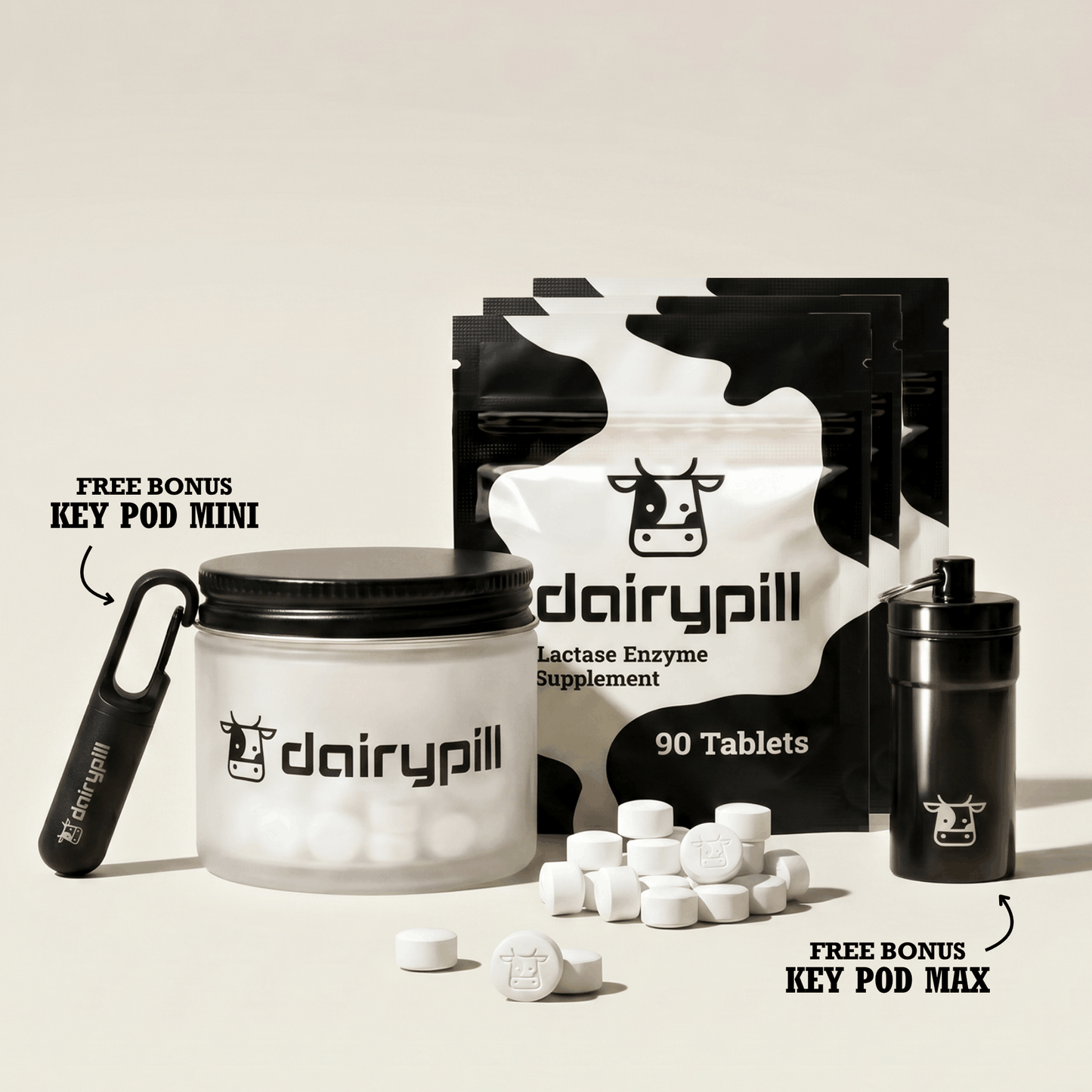
The lactase supplement category appears simple on the surface. Underneath, the differences between products are significant.
The Enzyme That Makes Dairy Digestible
According to StatPearls, lactose intolerance stems from insufficient lactase enzyme activity in the small intestine — preventing the body from breaking down dairy sugar. When lactase enzyme levels are low, undigested lactose ferments in the large intestine, producing gas, bloating, and cramping. A lactase enzyme tablet supplements what the body cannot produce on its own. Whether it works depends entirely on whether the dose matches the individual's intolerance level.
Why Most People Are Using The Wrong Dose
Most lactase enzyme tablets contain 3,000–9,000 FCC and are designed for mild intolerance. If you still have symptoms after taking a standard tablet before a dairy meal, that is not evidence enzyme support fails. It is evidence the dose was too low.
What Separates A Good Lactase Tablet From A Great One
The best lactase digestive aids deliver enough enzyme at a verified activity level in a clean formula, and they are practical to carry and reliable enough to trust before every dairy meal.
What To Look For Before Buying Lactase Enzyme Tablets
Buying the wrong supplement wastes time and erodes confidence. These are the factors that actually predict whether a tablet will perform.
FCC Count Is The Number That Matters Most
FCC measures enzyme activity, not just the amount present. Two tablets with identical milligrams of lactase enzyme can have completely different FCC counts depending on purity and potency. When evaluating the best lactase supplements, FCC is the only reliable comparison. Anything under 6,000 FCC is unlikely to provide full coverage for moderate to severe intolerance.
Ingredient Transparency And Formula Cleanliness
DairyPill contains one active ingredient — lactase enzyme at 18,000 FCC — and three non-active ingredients: Microcrystalline Cellulose, Crospovidone, and Magnesium Stearate. Non-GMO, gluten-free, and preservative-free.
Third-Party Testing And Manufacturing Standards
Enzyme activity claims are only meaningful if independently verified. DairyPill is manufactured in the United States in a GMP-certified facility and third-party batch tested for quality. That means each batch is produced under established supplement manufacturing standards and tested to verify consistency, safety, purity, and strength. Additionally, every production run is tested for heavy metals, pathogens, and optimal disintegration speed.
Portability And Everyday Usability
The best lactase enzyme tablets come in packaging built for real life. DairyPill's Starter Kit includes a Key Pod Mini (holds 4 pills) and a Key Pod Max (holds 16 pills) — compact keychain cases that keep pills accessible wherever you are.
The Best Lactase Enzyme Tablets On The Market Right Now
Not every product earns this label. Here is how the options compare when evaluated on what actually matters.
- What Most Options Get Wrong: Most top lactase tablets prioritize low cost over effective dosing. They handle mild loads but leave anyone with significant intolerance still symptomatic. Competing on price without potency results in a product that consistently disappoints.
- How DairyPill Compares To The Rest: Lactaid Original contains 3,000 FCC. Lactaid Fast Act contains 9,000 FCC. DairyPill contains 18,000 FCC — six times the enzyme activity of Lactaid Original per pill. One pill handles a full dairy meal without stacking tablets.
- Why 18,000 FCC Changes The Conversation: At 6x the strength of Lactaid Original, 18,000 FCC shifts the goal from symptom management to prevention. For people who tried weaker options and gave up on dairy, the potency gap is the explanation they were looking for.
How To Use Lactase Tablets For Maximum Effect
Taking the right tablet is half the equation. Using it correctly is the other half.
Timing Your Dose Before A Meal
According to the National Institute of Diabetes and Digestive and Kidney Diseases, taking a lactase enzyme supplement before eating dairy is the recommended approach for managing symptoms. Take DairyPill before a dairy-containing meal to position the enzyme in the small intestine before lactose arrives. Taking it after eating reduces its effectiveness significantly.
Adjusting For Heavier Dairy Meals
One DairyPill handles most dairy situations. For heavier meals or more severe intolerance, an additional pill is an option. Lactase enzyme is a naturally occurring enzyme that is safely excreted when taken in excess.
Making It A Consistent Daily Habit
Consistent use produces consistent results. Reaching for a DairyPill before every dairy meal eliminates guesswork and prevents unexpected symptoms from a missed dose.
Who Benefits Most From A High-Potency Lactase Supplement
High-potency enzyme support is not only for severe cases. These are the groups that see the most meaningful improvement.
Adults Who Developed Intolerance Later In Life
Research published in Nutrition Reviews confirms that lactase enzyme production naturally declines with age in most adults. People who tolerated dairy for decades but now experience new symptoms need a supplement strong enough to compensate for reduced output. Low-dose options rarely bridge that gap adequately.
People Whose Current Supplement Is Not Working
Research published in JGH Open confirms that orally supplemented lactase enzyme significantly reduces symptoms in people with lactose intolerance. If an existing supplement is not delivering relief, the issue is almost always the FCC count. Switching to a higher-potency option tends to resolve it without any other changes.
Anyone Who Eats Dairy In Social Or Unplanned Settings
Restaurants, events, and travel involve limited control over ingredients. A reliable lactase enzyme digestive aid that covers a wide range of dairy loads is the most practical solution for unplanned situations.
These statements have not been evaluated by the Food and Drug Administration. This product is not intended to diagnose, treat, cure, or prevent any disease.
Sources:
- Malik, Talha F., and Koushik K. Panuganti. "Lactose Intolerance." StatPearls, National Center for Biotechnology Information, U.S. National Library of Medicine, 6 Aug. 2025, www.ncbi.nlm.nih.gov/books/NBK532285/.
- "Treatment for Lactose Intolerance." National Institute of Diabetes and Digestive and Kidney Diseases, U.S. Department of Health and Human Services, www.niddk.nih.gov/health-information/digestive-diseases/lactose-intolerance/treatment.
- Lee, Martin F., and Stephen D. Krasinski. "Human Adult-Onset Lactase Decline: An Update." Nutrition Reviews, vol. 56, no. 1, Jan. 1998, pubmed.ncbi.nlm.nih.gov/9481112/.
- Baijal, Rajesh, and R. K. Tandon. "Effect of Lactase on Symptoms and Hydrogen Breath Levels in Lactose Intolerance: A Crossover Placebo-Controlled Study." JGH Open, vol. 5, no. 1, 2020, pp. 143–148, pmc.ncbi.nlm.nih.gov/articles/PMC7812489/.